Bossa Nova: a shelf-checking robot that stopped when Walmart ended the deal
Bossa Nova’s shelf-scanning robot started in 50 Walmart stores in 2017 and grew to about 500. When Walmart ended the relationship in November 2020, the company moved away from robot-centered business.

Timeline
- 2017Walmart trial50 stores
- 2020.01Expansion plan350 stores to 1,000
- 2020.11Walmart ends dealAbout 500 stores
- After 2020Turns to AI analyticsLayoffs, robots downplayed
An inventory robot from a toy company
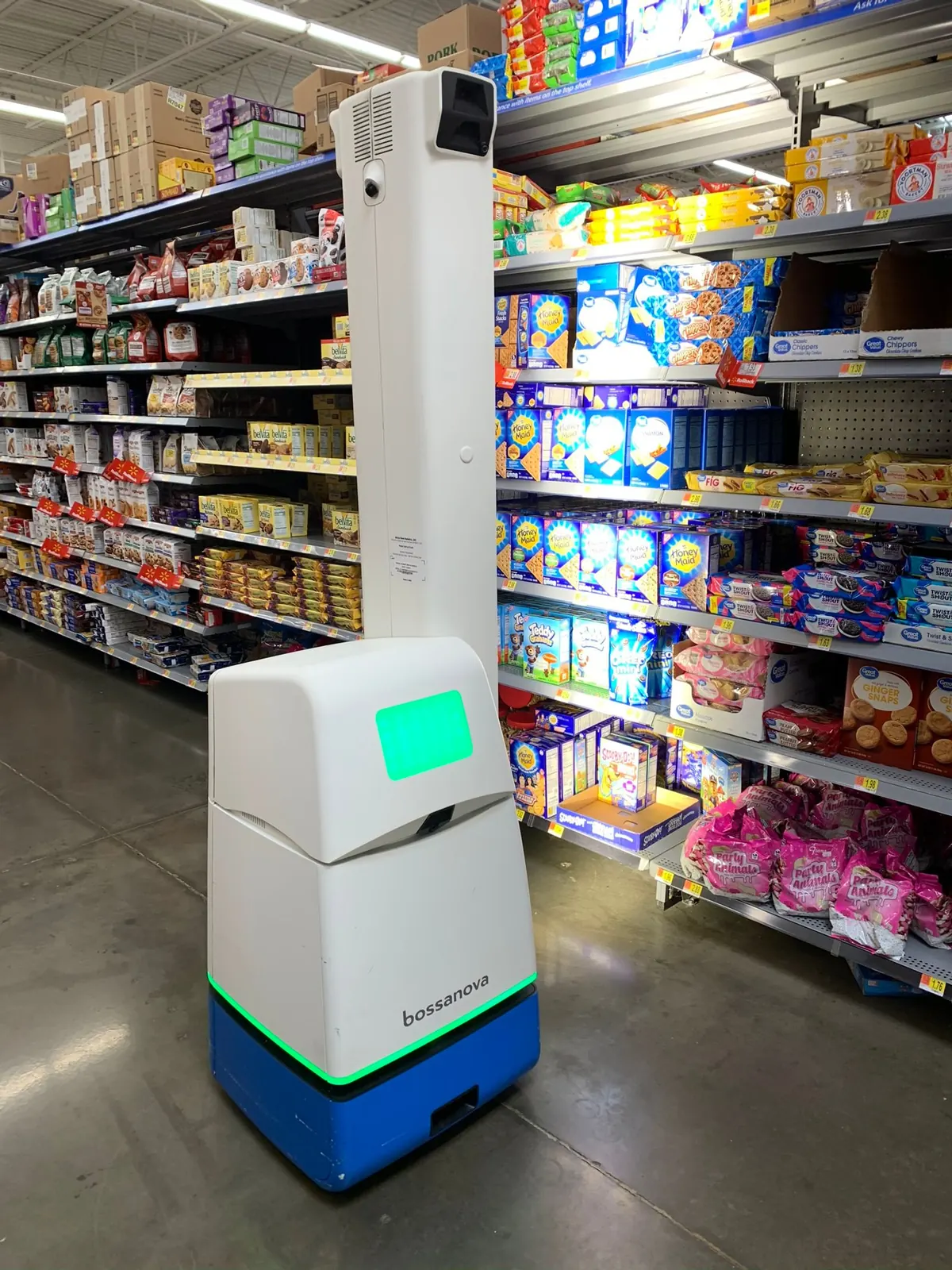
Bossa Nova Robotics was founded in 2005 by Carnegie Mellon doctoral students. TechCrunch reported that it first made toys such as a robotic penguin and a gorilla, which sold with limited success. It then turned to a robot that drives store aisles checking inventory. The robot photographs shelves with cameras, the images are analyzed in the cloud, and associates are told about out-of-stock or misplaced products. Co-founder Sarjoun Skaff explained that the robot has no arms, so it does not restock shelves but takes over the tedious job of finding problems. Wikipedia (a secondary source) says it moves on four wheels at about 20 cm per second and uses 2D and 3D cameras and lidar to avoid obstacles and people. In 2017 Walmart announced it would test the robots in 50 stores, and that November TechCrunch reported that the company was raising a $17.5 million Series B.
The road from 350 to 1,000 stores stopped
In March 2018 Walmart was testing the robots in dozens of stores and said it was still a pilot. In April 2019 TechCrunch said the robot went up and down aisles three times a day, and the company’s website says it scanned aisles three times a day, seven days a week. In January 2020 the company said it was already in 350 stores and, with NCR, would grow to 1,000 that year. It also introduced a smaller new platform, Bossa Nova 2020, that was easier to steer through narrow aisles and added downward-looking cameras for fresh produce. On 2 November 2020, however, Walmart said it had ended its relationship with Bossa Nova, pulling robots from about 500 stores. Walmart said it had worked with the company for five years and learned a lot about how technology can assist associates and make jobs easier. The Wall Street Journal, citing unnamed people, reported that Walmart found human workers could get similar results, and AP relayed that there was also some concern about how shoppers reacted. According to The Robot Report, Walmart found different, sometimes simpler solutions, including having employees check inventory.
What was left of the company
Bossa Nova shut its European unit and reportedly laid off half its staff (The Robot Report). Wikipedia says it laid off more than 61 people. Skaff said he could not comment on Walmart, but that the pandemic had forced the company to streamline and focus on core technologies. The company then moved to image-based AI analytics and barely mentions robots on its website. It said it still ran proofs of concept with large retailers but would not name them. In November 2026 its site describes experience building robots and cloud AI in 600 Walmart Supercenters and is run as a site that shares lessons with startups.
Shoppers watched, or worried
In ABC7’s 2018 report some shoppers worried that automation would cost jobs, while others thought it would make trips smoother. Walmart said it was collecting feedback from associates and customers on whether the robots got in the way, and that they would likely run in the early morning. We found no design evaluation or award for the robot’s appearance. The shopper reactions cited in 2020 were not described in any detail. Skaff described the robot as taking over the search for problems rather than staff jobs. The unnamed people the WSJ cited, by contrast, said Walmart believed humans could get the same result.
What this case shows
The reasons for the withdrawal that this record can confirm are the two the WSJ gave through unnamed sources: humans could get similar results, and there was concern about shopper reactions. Walmart itself only said it had learned a lot over five years. That a robot without arms left associates to fix the problems it found is stated in Skaff’s 2019 explanation. The Robot Report called Walmart the company’s primary customer, and after that customer left the company changed direction.
If staff have to fix the problems a robot finds anyway, what is finding them first worth?
What we haven’t confirmed
- The number of robots actually in operation and the cost per store
- Walmart’s own official explanation of why it ended the contract (we could not open the WSJ original)
- Whether the company still has a robot business, and the size of its layoffs (sources differ)
- Any published design intent, design award or study of shopper reactions
Sources
- TechCrunch, “Bossa Nova raises $17.5 million for retail robots,” 14 November 2017
- ABC7 Los Angeles, “Robots in action at select Walmart stores nationwide,” 23 March 2018
- TechCrunch, “The startup behind Walmart’s shelf-scanning robots,” 10 April 2019
- Automated Warehouse, “Bossa Nova Deploys to 1000 Walmart Stores,” 13 January 2020
- CBS News (AP), “Walmart laying off shelf-scanning robots to let humans do the work,” 2 November 2020
- Spokesman-Review (AP), “Walmart abandons shelf-scanning robots, lets humans do work,” 2 November 2020
- The Robot Report, “Bossa Nova de-emphasizes robots in ‘retail AI’ rebrand”
- Bossa Nova, company website (checked November 2026, company material)
- Wikipedia, “Bossa Nova Robotics” (secondary source)