Care-O-bot: a German institute’s home assistant robot through four generations
Care-O-bot is a home assistant robot developed by Germany’s Fraunhofer IPA since 1998. It was tested in a nursing home and an electronics store, and a spin-off was set up to commercialise it.

Timeline
- 1998First prototype
- 2008.06Gen 3 shownAUTOMATICA, Munich
- 2015.01Gen 4 announcedModular design
- 2016.10Store guideSaturn, Ingolstadt
- 2018.09Last newsStatus unknown since
From a 1998 prototype to a fourth generation in 2015
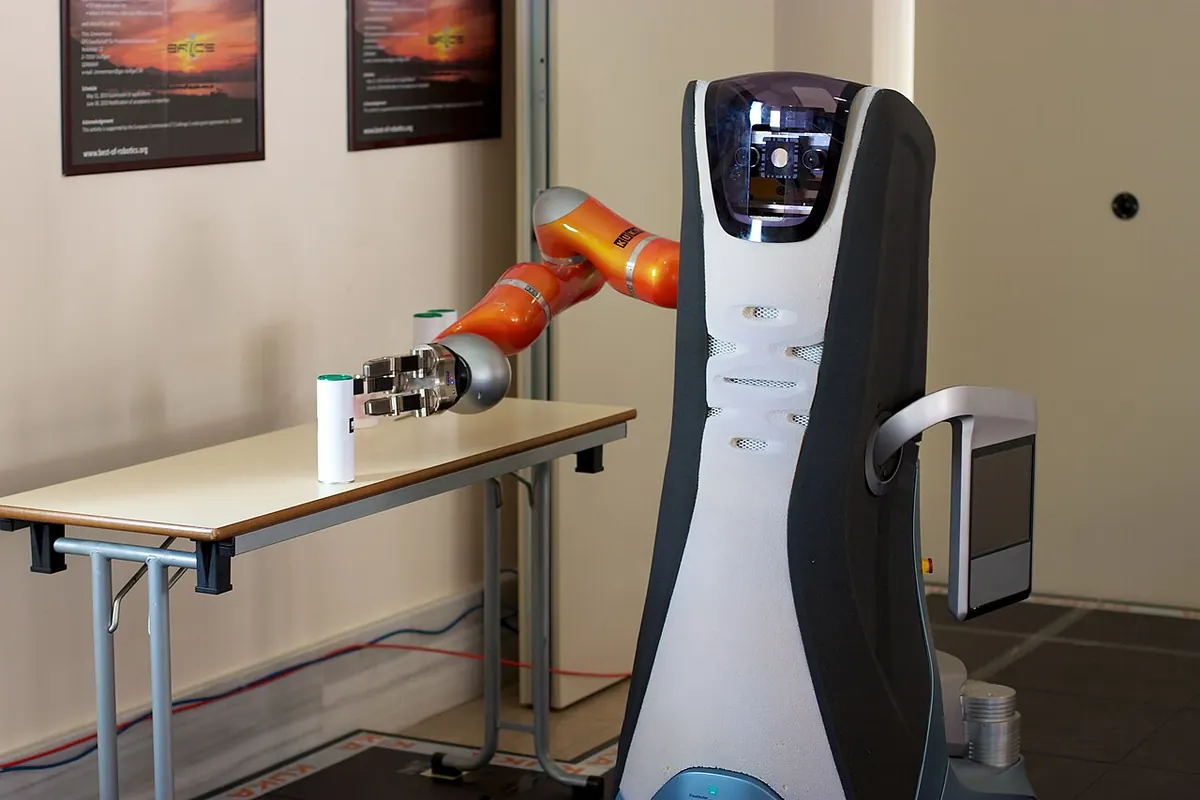
Care-O-bot is a home assistant robot from Fraunhofer IPA in Stuttgart, Germany. The first prototype, built in 1998, was a mobile platform with a touchscreen. It served as an exhibition guide in 2001 and was the basis for three museum robots in Berlin. The second generation in 2002 added an arm and an adjustable walking support. The third, shown at AUTOMATICA in Munich in June 2008, had a 7-axis arm and a tray at the front, with a serving side and a working side. The fourth, announced in January 2015, was developed with the design firm Phoenix Design and the component maker Schunk. It was modular, with a choice of zero to two arms, and won a Red Dot “Best of the Best” product design award in 2015.
From the lab to a nursing home and a store
The third generation was a ROS-based research platform used by many universities and research institutions, and it could be installed or rented. In 2011 the WiMi-Care project tested it for three days in a care home with a dementia unit. The robot filled cups from a water dispenser, served them on its tray, and launched games and music on its screen. The fourth generation was due to go on sale in Europe from the second half of 2015, but no price was announced. From late October 2016 a fourth-generation robot named Paul greeted customers at a Saturn electronics store in Ingolstadt. The spin-off Mojin Robotics was set up to commercialise it and won a Fraunhofer start-up award in February 2018.
Residents watched with curiosity
Theo Jacobs, the Fraunhofer IPA researcher who monitored the nursing-home trial, said: “The residents simply observed Care-O-bot® with curiosity and found it fascinating to watch it doing its work.” According to the institute, residents showed no fear of contact with the robot, and some in the dementia unit developed a real fondness for it. The carers, too, could well imagine working with a service robot in future. Paul won the EHI Award 2017 for Best Customer Experience.
Long research, then the product news stopped
Care-O-bot carried on for about twenty years through new generations, as a research platform and in pilot uses. But no sales figures were published, and news on the Care-O-bot site stops in September 2018. It is worth comparing with Lio from Switzerland, which runs errands in care facilities.
What would this robot need beyond pilot use to become a regular product?
What we haven’t confirmed
- How many third- and fourth-generation units were built or sold
- When Mojin Robotics was founded, its current status, and whether the fourth generation can still be bought
- The height and weight of the fourth generation
- The results of the Saturn store trial after six months
Sources
- Care-O-bot, Care-O-bot I (institute page)
- Care-O-bot, Care-O-bot II (institute page)
- Care-O-bot, Care-O-bot 3 (institute page)
- Care-O-bot, Care-O-bot 4 (institute page)
- Care-O-bot, News (institute page)
- Graf et al., “Robotic Home Assistant Care-O-bot® 3 – Product Vision and Innovation Platform,” 2009
- Fraunhofer IPA, “Service robots in nursing homes: popular among residents and carers alike,” July 2011 (company material)
- Fraunhofer IPA, “Robots as multifunctional gentlemen,” 15 January 2015 (company material)
- New Atlas, “Care-O-bot gets an upgrade, now flirtier and available with optional second arm,” 20 January 2015
- IEEE Spectrum, “Care-O-bot 4 Is the Robot Servant We All Want but Probably Can't Afford,” 29 January 2015
- Fraunhofer IPA, “Care-O-bot® 4 celebrates its première as shopping assistant,” November 2016 (company material)
- High-Tech Gründerfonds, “Intelligent robotics – Fraunhofer start-up award 2017 for Mojin Robotics GmbH,” February 2018