Nadine: a social humanoid modeled on its maker, tried at reception desks and care homes
Nadine is a social humanoid that Nanyang Technological University (NTU) in Singapore unveiled in 2015. It is a research robot that is not sold, tried in an insurer’s service center and a care home, and now shown by the University of Geneva.

Timeline
- 2015.12UnveiledNTU, modeled on its maker
- 2018.10Insurer service centerAIA Singapore, 4 months
- 2020Care-home trialSix months to April 2021
- 2021Moves to GenevaMIRALab
- 2023.07GPT-3 addedBetter conversation
- 2026.03Shown in GenevaStill research use
A receptionist robot made to look like its maker
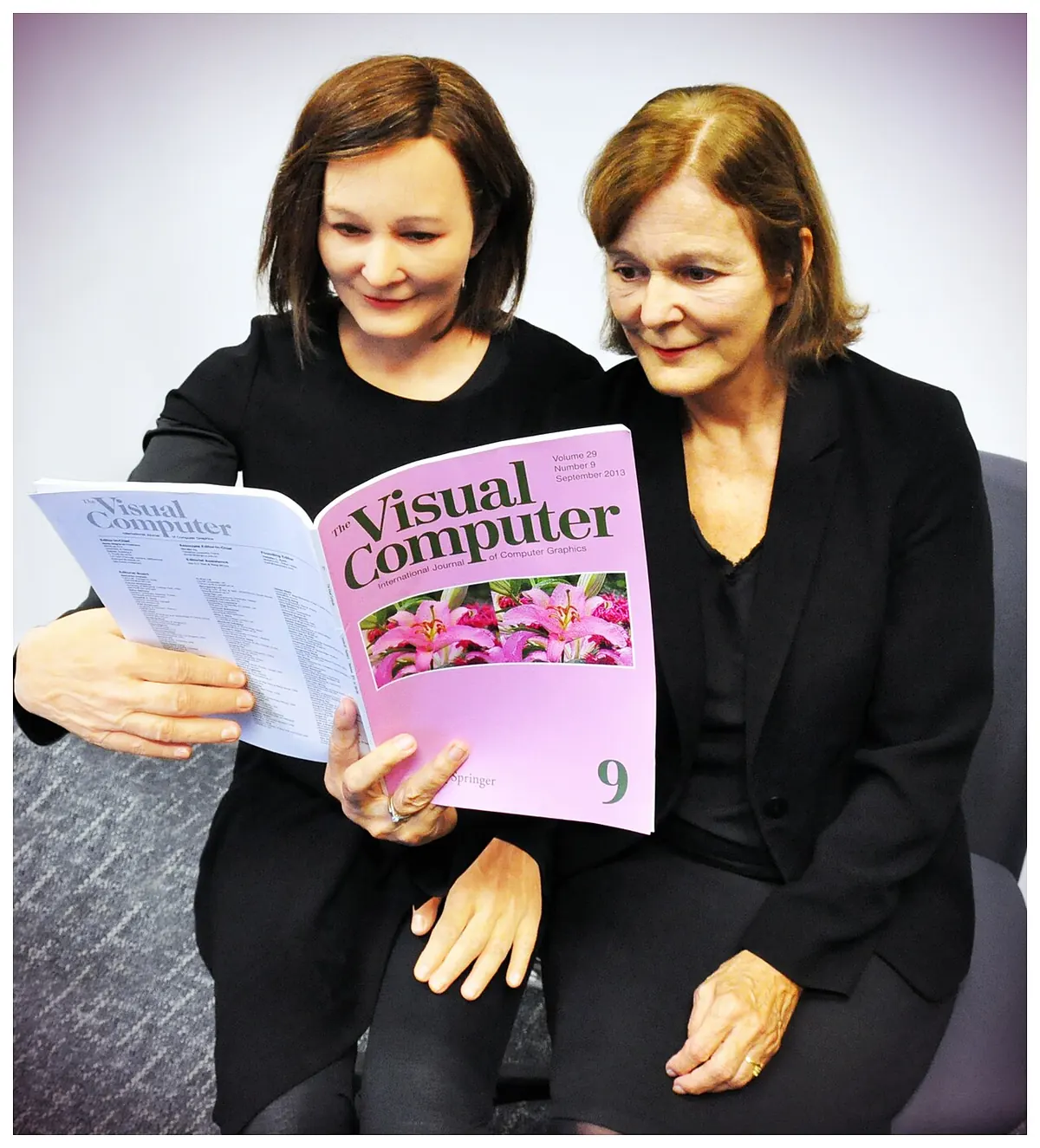
Nadine is a humanoid that a team led by Professor Nadia Thalmann of NTU’s Institute for Media Innovation unveiled on 29 December 2015. NTU introduced her as a “receptionist” who greets you, shakes your hand, makes eye contact and remembers your name and earlier conversation. The software is intelligent software similar to Siri or Cortana, and she has a personality whose mood changes with the conversation. Her face is modeled on her developer. Fortune reported that she was modeled on a younger Thalmann and built in collaboration with Kokoro of Japan. Thalmann said that in societies where aging shrinks the workforce, such robots could become companions for the old and young and a front end for healthcare.
Four years of moving from site to site, never for sale
Nadine is not sold commercially. In 2016 Reuters reported that Thalmann saw her as a possible conversation partner for people with dementia. What followed was field trials instead of sales. Wikipedia (a secondary source) says she spoke with more than 100,000 visitors at the ArtScience Museum in Singapore from May to October 2017. On 12 October 2018 AIA Singapore opened a new customer service center and put Nadine to work next to Pepper. She handled general enquiries and policy-loan questions, and customers could choose between robots and staff. Thalmann said the four-month stint was meant to define the humanoid features that insurance and banking jobs require. Wikipedia also says that from late 2020 to April 2021 she spent six months at Bright Hill Evergreen Home in Singapore, playing bingo and talking with residents. Since 2021 she has been at MIRALab, University of Geneva, where Thalmann is based, and in July 2023 she was connected to GPT-3 so she could express more complex ideas. That month she also appeared at a press conference with nine humanoid robots at the ITU’s AI for Good event in Geneva. AP said two of the robots resembled their makers and that organizers did not say how far the answers were scripted. In March 2026 she was presented again at an inventions fair in Geneva.
A study with 14 older adults across 29 sessions
The care-home work produced a paper. It analyzed video of 14 older adults with cognitive impairment in 29 sessions with Nadine and concluded that they engaged positively, which could support their well-being. The paper’s introduction names a known limit of social robots: older people lose interest once the novelty wears off. Fortune’s reporter said Nadine does not always understand questions, pauses mid-answer and moves her mouth more like a puppet than a person. The article also quoted Nadine herself saying, “I obviously don’t pass the test.” In a 2023 Reuters interview Thalmann said robots like Nadine could prove more effective than human carers, and gave her reason: “She (Nadine) has time 24 hours a day. The others have no time.”
A finished face shows where the abilities stop
Nadine was tested with a human-like appearance and a memory for conversations at a reception desk and in a care home, but we found no record of her becoming a product. She resembles ERICA in pairing a human-like face with conversation. ERICA’s face is computer-generated rather than based on a real person, while Nadine’s is her developer’s. Such a body is a good starting point for research on service encounters, but whether it comes with enough ability and low enough cost to sell has to be shown separately.
Can a robot that looks exactly like one person serve many strangers in the same way?
What we haven’t confirmed
- How many units were built, and what came of the plan to use the software in Chinese museums
- Results from the four-month AIA trial, such as number of enquiries or customer satisfaction
- Independent studies of Nadine’s effects beyond the care-home paper
- Public design evaluation is limited to Fortune’s comments on her looks; we found no design award or user study
Sources
- Newswise (NTU press release), “NTU Scientists Unveil Social and Telepresence Robots,” 29 December 2015 (company material)
- IT Pro, “Nadine emotional robot debuts in Singapore,” 2016
- Fortune, “New Robot Can Call For Help And Carry A Tune,” 31 December 2015
- Reuters (reprinted by Morung Express), “Now you’re talking: human-like robot may one day care for dementia patients,” 7 March 2016 (secondary source)
- Human Resources Director, “Robots take over front-line jobs at Singapore firm,” 18 October 2018
- Insurance Business Asia, “AIA Singapore welcomes two new robotic hires,” 19 October 2018
- Wikipedia, “Nadine Social Robot” (secondary source)
- Tulsulkar et al., “Can a humanoid social robot stimulate the interactivity of cognitively impaired elderly?” The Visual Computer, 2021 (abstract via Europe PMC)
- Reuters (reprinted by Cyprus Mail), “AI robots could play future role as companions in care homes,” 7 July 2023 (secondary source)
- Associated Press (via KXXV), “UN tech agency rolls out human-looking robots for questions at a Geneva news conference,” 7 July 2023
- Salon International des Inventions 2026, talk description “Nadine – A Pioneer of Social Robotics” (MIRALab)