Serve: a Postmates spinoff whose sidewalk delivery fleet passed 2,000 robots
Serve is a sidewalk delivery robot that the delivery app Postmates unveiled in 2018. It spun out as an independent company in 2021 and passed 2,000 robots at the end of 2025, but in 2026 it chose not to renew its contract with Uber.

Timeline
- 2018.12UnveiledPostmates, Los Angeles
- 2021.03Spin-offFrom Postmates
- 2024.04Nasdaq listingSERV
- 2025.122,000+ robots
- 2026.08In operationUber contract ends 2027
A 50-pound sidewalk robot built by a delivery app
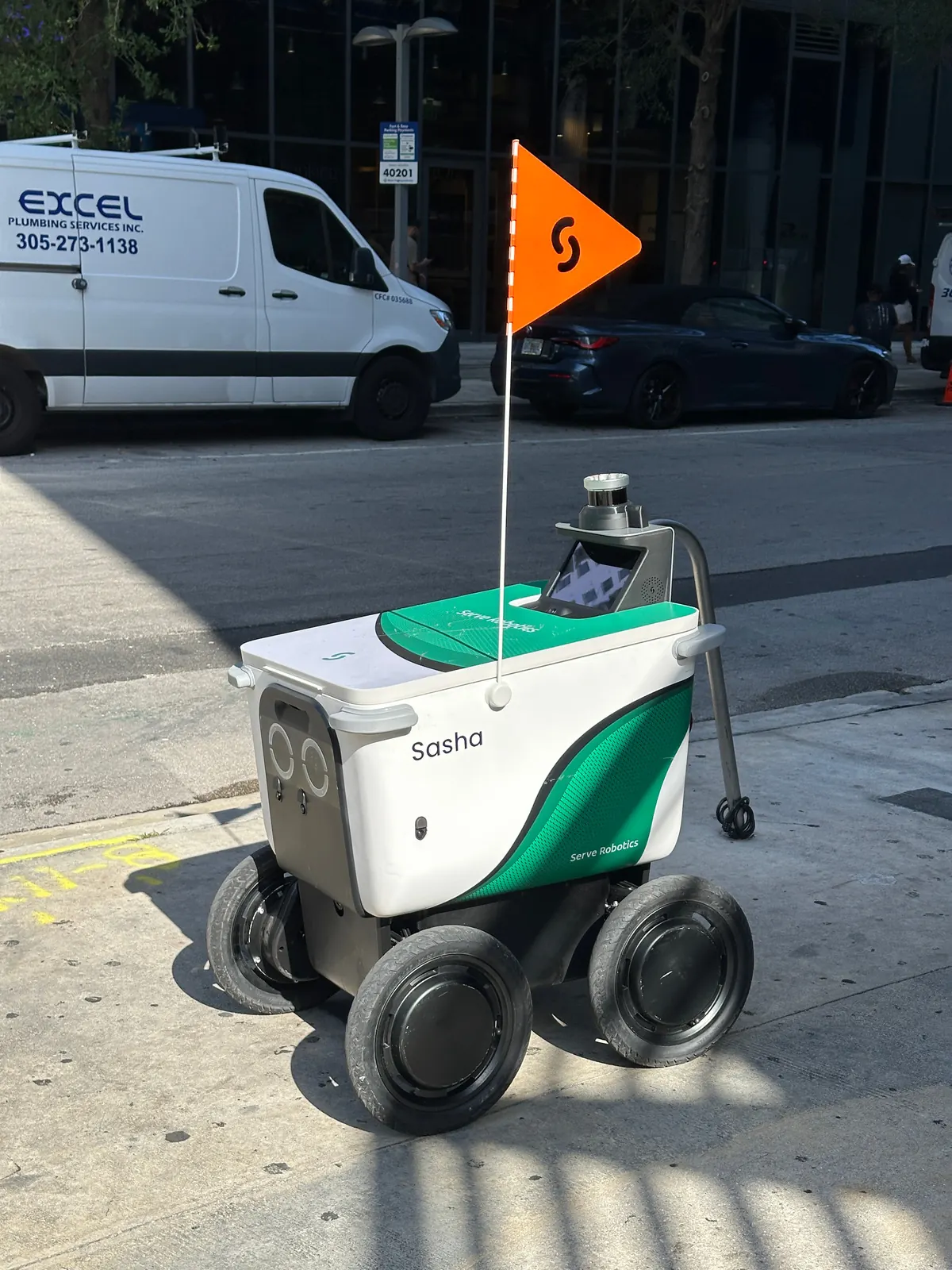
Serve is a delivery robot that the US food delivery app Postmates unveiled in Los Angeles in December 2018. It is a box on wheels with a light ring on top, and blinking eyes show which way it is heading. It travels on sidewalks at walking pace and uses lidar to avoid obstacles and pedestrians. It carries up to 50 pounds, and customers open it with a smartphone or a code. Remote staff monitor its trips.
A 2021 spinoff, then twenty times bigger in 2025
After Uber bought Postmates, the robotics division became an independent company, Serve Robotics, in March 2021. Uber stayed on as an investor, and Uber Eats became its first commercial partner. The company listed on Nasdaq in April 2024. That October it announced a third-generation robot built by Magna, which it said was twice as fast and went twice as far as before. In Q2 2024 an average of 48 robots made deliveries each day. By December 2025 the fleet had passed 2,000. In January 2026 Serve bought Diligent Robotics, the maker of the hospital robot Moxi.
2,000 robots, 792 on the road each day
The work did not grow as fast as the fleet. In Q2 2026 quarterly delivery volume through Uber fell for the first time since 2022, and the company cut its 2026 revenue guidance from $26 million to $9–10 million. That quarter an average of 792 robots ran each day. Advertising made up nearly half of food delivery revenue. CEO Ali Kashani said Serve would not renew its Uber contract in 2027: “We just have a different idea for what we want next.” Uber sold its entire stake, and Serve widened its partners to DoorDash and Grubhub.
More robots is not the same as more work
Serve grew its fleet quickly through investment and manufacturing. But the work its robots did depended on how many orders the delivery apps passed on. In 2026 the company announced Beacon, a device it gives restaurants for free. Kashani said it would let Serve connect with restaurants directly instead of going through fragmented third-party software. Kiwibot, elsewhere in this archive, took a different path by settling into a long contract with one campus food-service company.
If another company decides what work a robot gets, who is designing that robot’s usefulness?
What we haven’t confirmed
- When the first paid deliveries began after the 2018 unveiling
- Total deliveries to date
- What happened in a September 2025 incident in Los Angeles involving a robot and a mobility scooter user (found only in a secondary source)
- Where the headquarters is (sources give Los Angeles and Redwood City)
Sources
- MIT Technology Review, “Postmates has launched a delivery robot that will bring lunch to your door,” 14 December 2018
- Engadget, “Uber spins out Postmates’ robot delivery division into a separate company,” 2 March 2021
- Serve Robotics press release, “Serve Robotics spins out of Postmates with seed funding from Neo to build the next generation of sidewalk delivery robots,” 2 March 2021 (company material)
- The Robot Report, “Serve Robotics closes $13 million funding round,” 6 December 2021
- Serve Robotics, press release on its $40 million public offering and Nasdaq uplisting (SEC 8-K exhibit), 17 April 2024 (company material)
- Restaurant Dive, “Serve Robotics debuts faster, larger robots for Uber Eats deal,” 16 October 2024
- Serve Robotics press release (on Nasdaq), “Serve Robotics Builds 2,000 Autonomous Delivery Robots, Creating Largest Sidewalk Delivery Fleet in the U.S.,” 12 December 2025 (company material)
- TechCrunch, “Why Serve Robotics is acquiring a hospital assistant robot company,” 20 January 2026
- Axios, “Serve Robotics plots new strategy after breakup with Uber Eats,” 17 August 2026
- Bloomberg article (republished by The Spokesman-Review), “Serve Robotics expands DoorDash deal, adds Grubhub post-Uber Split,” 17 August 2026
- The Robot Report, “Serve Robotics to deploy its autonomous delivery robots with Grubhub,” 19 August 2026
- Wikipedia, “Serve Robotics” (secondary source)