Unitree G1: a research humanoid priced down to $16,000
The G1 is a 1.32 m humanoid that China’s Unitree revealed in May 2024. Priced 90% below its predecessor, the H1, it sells mainly to labs and educational institutions.

Timeline
- 2024.05Revealed$16,000
- 2024.08Production versionSales begin
- 20255,500 humanoidsAll models combined
- 2026.03IPO filingShanghai STAR Market
- 2026.11On saleFrom $13,500
A humanoid known first for its price
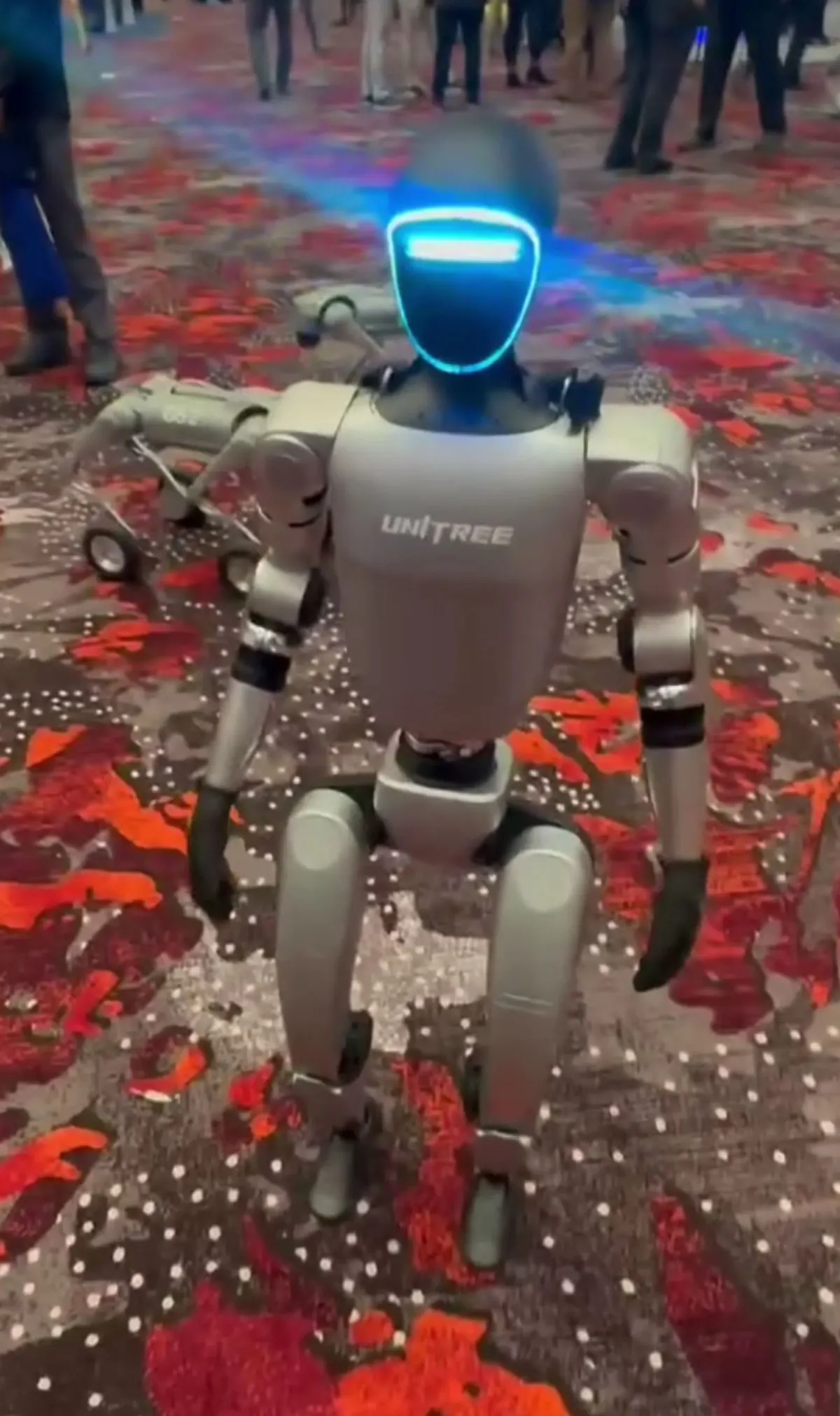
The G1 is a humanoid Unitree revealed in May 2024. Its predecessor, the H1, had debuted at over $150,000, and the G1 arrived at $16,000, which Maginative called 90% cheaper. Unitree began its humanoid project in February 2023 and built the H1 in six months. The G1 is 1.32 m tall and weighs about 35 kg. According to the official page it folds down to 690 mm. It has 23 joints, and the EDU version up to 43. Maginative singled out the hollow-joint wiring as a key feature. We found no interview in which the company explained the form itself. The product page says the joints move through a wider range than a person’s and that the robot folds for carrying, and it presents imitation and reinforcement learning as the way it picks up new skills.
A production version three months later
Maginative reported a production version three months after the reveal, and heise wrote that the price started at $16,000 with a costlier EDU version that has tactile hands. Free Malaysia Today said in August 2024 that the G1 and H1 were on sale. The official page now starts at $13,500. That price does not include hands, and the base model does not support secondary development. Warranty is 8 months for the base model and 18 for the EDU. G1-only unit sales are not public. According to the listing documents Unitree filed in March 2026, 2025 revenue was RMB 1.71 billion, up 335%, and humanoid shipments passed 5,500 units. That figure covers all humanoid models, including the G1, and the company said it was 32.4% of global shipments. An Omdia report from the same period put Unitree second at 4,200 units behind AgiBot (Robonaissance). The average selling price of its humanoids fell 71.7%, from RMB 593,400 in 2023 to RMB 167,600 in the first three quarters of 2025. In replies during the listing review, the company said 73.6% of its humanoid revenue in those three quarters came from research and education customers and 9.0% from industry.
Welcomed as lab equipment, judged not a home robot
Maginative expected the G1 to speed up humanoid development in academic labs and to put pricing pressure on rivals. The same outlet noted that it could not yet do consumer tasks such as cooking or tidying and that Unitree sees it as an R&D platform. TechRadar’s reporter wrote that the G1 has a haunting faceless head and does not ship with hands. Hands cost extra and the video notes that some skills are still in development, so it was not clear exactly what a buyer gets for $16,000. The reporter also pointed out that the battery lasts about two hours with no sign that the robot can recharge itself. The fine print in the official video tells viewers to keep a sufficient safe distance and use it with caution, and TechRadar noted that it is not intended as a home robot. Wikipedia (a secondary source) says the G1 became the basis of public-facing robots puppeted by remote operators, such as Poland’s “Edward Warchocki” and America’s “Rizzbot”.
A cheaper body widened the research market
The G1 cut the price enough for labs and schools to buy a humanoid. The base model leaves out hands and secondary development, and TechRadar noted that some skills in the video were still in development. A faceless head is a different choice from ERICA, which follows the human face, and from Ameca, which was deliberately made to look robotic. The G1 is judged on movement and price rather than expression.
If a robot without a face or hands becomes a researcher’s first humanoid, where does that set the field’s expectations?
What we haven’t confirmed
- G1-only unit sales and price changes (the published figures cover all of the company’s humanoids)
- The date mass production began in August 2024, and why the base model shipped without hands from the start
- The post-listing situation (Wikipedia lists the company as public, but dates came only from secondary sources)
- Any published design intent or design award (we found no design interview with the company)
Sources
- Maginative, “Unitree Robotics Unveils Affordable G1 Humanoid Robot,” 2024
- TechRadar, “You won’t believe how this robot can move – and the abuse it can take,” 2024
- Maginative, “Unitree Launches Production Version of G1 Humanoid Robot,” 2024
- heise online, “Humanoid robot: Unitree makes G1 fit for mass production,” 2024
- Free Malaysia Today (Paris dispatch), “Chinese company’s humanoid robots are now for sale,” 23 August 2024
- Unitree Robotics, official G1 product page (checked November 2026, company material)
- Wikipedia, “Unitree Robotics” (secondary source)
- Hello China Tech, “Unitree’s $610M IPO Shows What Humanoid Robotics Really Sells,” 25 March 2026 (analysis of the listing documents, secondary source)
- Robonaissance, “Unitree Filed for a $7 Billion IPO,” 11 May 2026 (secondary source)
- Humanoids Daily, “Inside Unitree’s Prospectus: Revenue Climbs and Profits Dip,” 2026 (secondary source)