PR2: the $400,000 personal robot that reached only about 50 labs
PR2 is a two-armed personal robot that Willow Garage loaned and sold to researchers. It went to 11 beta sites in 2010, and when Willow Garage closed in early 2014, support passed to Clearpath Robotics.

Timeline
- 2010.05Beta sitesLoaned to 11
- 2010.09On sale$400,000
- 2013.02Nearly 50 unitsCompany figure
- 2014.01Maker closesSupport to Clearpath
$400,000 and two arms for a personal robot
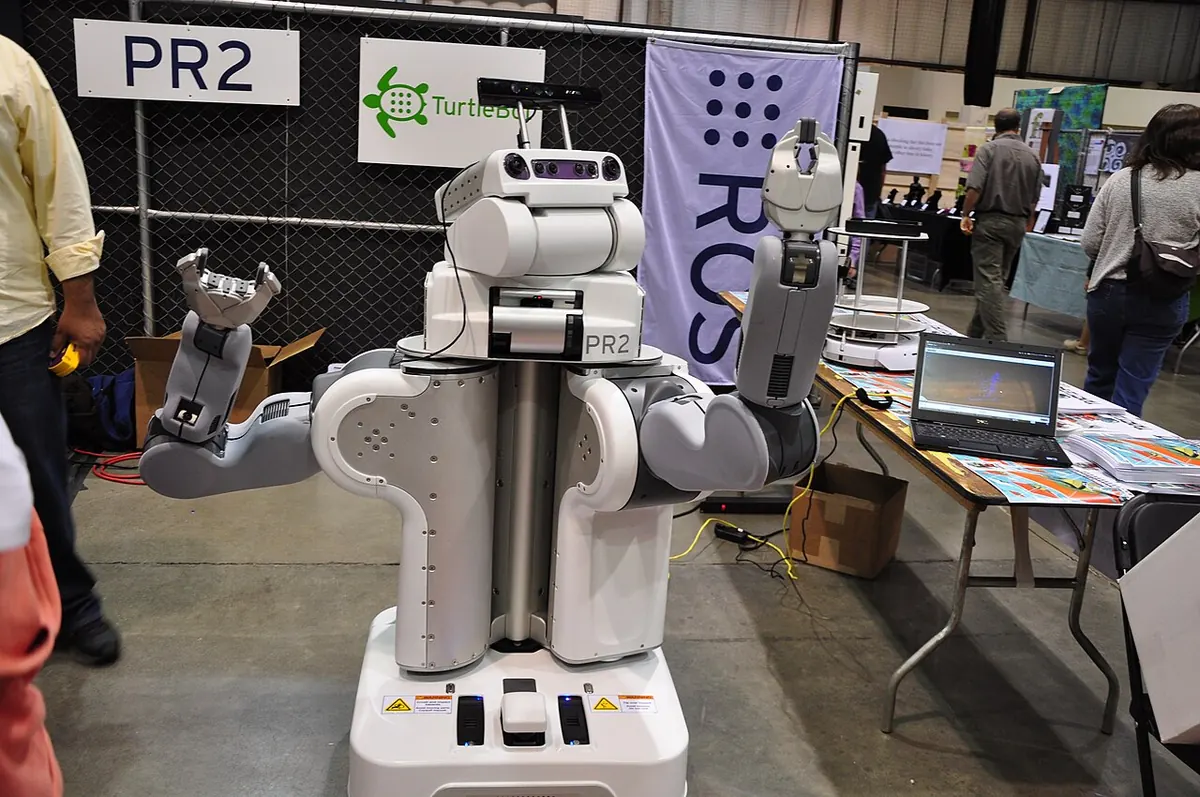
PR2 (Personal Robot 2) was built by Willow Garage, the lab Scott Hassan founded in 2006. It was closer to a platform for researchers to share than to a product. In 2009 CEO Steve Cousins said: “For what Linux is to PCs, we’d like to build the same thing for robots.” A roughly adult-height body stands on a rolling base, with two arms the size of human arms ending in grippers. It carries fingertip pressure sensors, two pairs of stereo cameras and a laser scanner. According to Palo Alto Online, the arms are held up by springs so they “float,” which lowers the risk of injury if the software malfunctions. The software was the open-source ROS. Here “release” means the May 2010 beta placements and the September purchase offer, not a retail launch.
Eleven free loans, then four first buyers
In May 2010 Willow Garage announced it would lend PR2s to 11 institutions for about two years, among them Stanford and MIT. In September it made the robot available at $400,000, with up to $120,000 off for open-source contributors. In December the first buyers were Samsung, France’s LAAS-CNRS, the University of Washington and George Washington University, and 16 institutions were using it. In February 2013 Willow said there were close to 50 PR2 robots in the world. That month it also said it would stop developing new research technology and move toward commercial work. In an August Spectrum interview Hassan said he had concentrated resources on Beam and saw the research as largely done. He also conceded that making PR2 affordable for homes or offices would have been a major challenge. He said: “it takes a hundred times more people to make an actual product.” In January 2014 support passed to Clearpath Robotics. Spectrum reported that Clearpath committed to at least three years of support, through 2016, and estimated about 40 PR2s in use. Bloomberg reported that Hassan had funded the lab with about $20 million of his own money a year. It gave no reason for the closure.
Towel folding from 24 minutes to 2
According to Palo Alto Online, a UC Berkeley PR2 took about 24 minutes per towel in 2010 and later about two. A PR2 that a Stanford student programmed took 40 minutes to fetch a drink from a café, against about 10 for a person. Georgia Tech’s Charles Kemp said that with the same robots, researchers “can run the same code,” so they can compare which methods work better. His lab used the PR2 to study robots that help care for seniors. Stanford’s Kenneth Salisbury said domestic robots should appear friendly and predictable, and warned that a robot moving “blindly” could frighten people. The robot weighed nearly 500 pounds and could not climb stairs.
A robot to run shared code on, not one to bring home
PR2 became a common platform that many labs used to share the same robot and code. Its backer admitted that bringing the price down to what a home or office could afford would have been a major challenge. Beam, which spun out of Willow, took pre-orders at $16,000 in September 2012 (see the Beam record), about one twenty-fifth of PR2’s price. Hassan called Beam “a gateway drug” to more advanced robotics.
Where does a robot that researchers can run shared code on split from one a household can bring in?
What we haven’t confirmed
- The total number of PR2s built (close to 50 is Willow Garage’s own statement)
- How many PR2s still work, and whether Clearpath support continued after 2016
- The specific reason Willow Garage closed (we found nothing beyond Hassan’s explanation)
- We found no published design awards or design reviews
Sources
- Tekla Perry, IEEE Spectrum, “Robots for Real: For Willow Garage, Robotics Is Personal,” 30 October 2009
- Travis Deyle, Hizook, “Willow Garage Selects Eleven Recipients of PR2 Beta Robots Valued at Over $400,000 Apiece!,” 4 May 2010
- MIT Technology Review, “Open-Source Robots Distributed” (no date on the page)
- Darren Quick, New Atlas, “Willow Garage’s PR2 robot now for sale,” 8 September 2010
- Erico Guizzo, IEEE Spectrum, “Willow Garage Sells First PR2 Robots,” 15 December 2010
- Scientific American, “2011: The Year of the Personal Robot?” (probably early January 2011, no date on the page)
- Evan Ackerman and Erico Guizzo, IEEE Spectrum, “UPDATED: Willow Garage to Shut Down? Company Says ‘No, Just Changing’,” 11 February 2013
- Jessica Leber, MIT Technology Review, “Willow Garage Won’t Do Research Anymore, but It’ll Sell You a Robot,” 12 February 2013
- Palo Alto Online, article on Willow Garage and the PR2 (15 March 2013 by its URL; we could not confirm the title on the page)
- Evan Ackerman, IEEE Spectrum, “Interview: Scott Hassan on Willow Garage and the Future of Suitable Technologies,” 27 August 2013
- Evan Ackerman, IEEE Spectrum, “Clearpath Robotics to Provide PR2 Support Through 2016,” 15 January 2014
- Bloomberg Businessweek, “Willow Garage’s Last Days” (20 February 2014 by its URL)
- IEEE Spectrum ROBOTS guide, “PR2” (secondary source)