Furhat: a face-projecting robot head that left the lab and took on LLMs
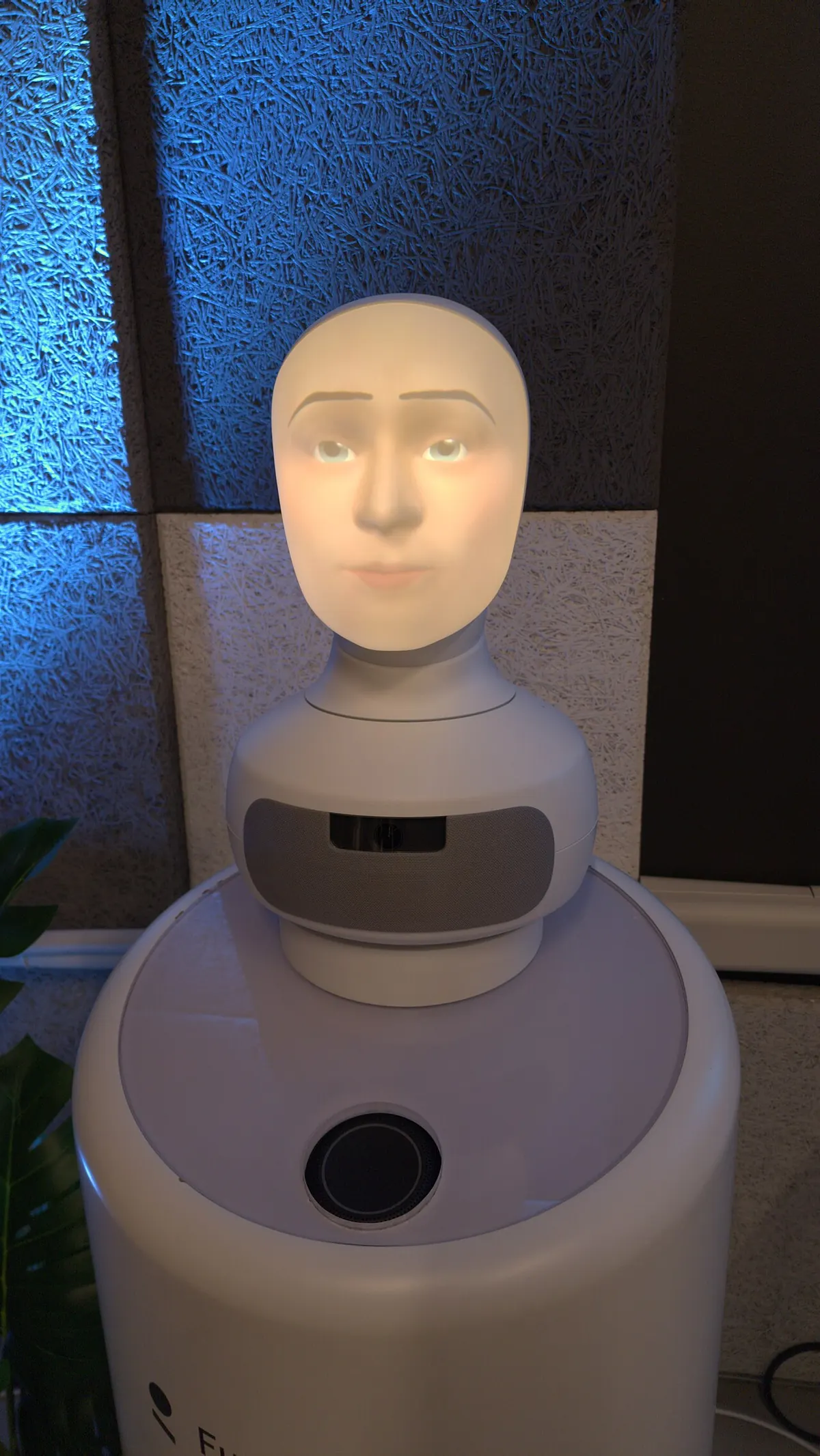
Furhat is a face-projecting social robot head that came out of research at Sweden’s KTH. It was announced as a commercial product in November 2018 and gained the LLM-based software FurhatAI in January 2025.

Timeline
- 2014FoundedFrom KTH research
- 2017.09Seed round$2.5M
- 2018.11Product launchWeb Summit
- 2022.01Acquires Misty Robotics
- 2025.01FurhatAI releasedLLM software; on sale
From a fur-hat prototype to a commercial product in 2018
Furhat was developed in the Department of Speech, Music and Hearing at KTH Royal Institute of Technology in Stockholm. Its name comes from a fur hat put on the first prototype. A computer-generated face is projected onto a 3D mask from behind, so the robot can talk with several people and turn to make eye contact with each one. KTH said this avoids the Mona Lisa effect seen on two-dimensional screens. The company was founded in 2014 on KTH research and raised a $2.5 million seed round from Balderton Capital and LocalGlobe in September 2017. In November 2018 it announced the robot at Web Summit as ready for the market. It looks like a smart speaker with a head and neck on top, and the company said it speaks more than 30 languages.
The Misty acquisition, then LLM software
The 2017 funding news said the Swedish public employment agency used the robot to prepare job candidates for interviews and to train teachers, and that Honda, KPMG, Intel, Merck and Toyota were building applications on the platform. In January 2022 Furhat Robotics bought the US company Misty Robotics for cash, at an undisclosed price. Misty makes mobile robots for developers, and Furhat said it would add its visual perception and conversational AI to future Misty robots. In January 2025 it released FurhatAI, LLM-based software. The company described FurhatAI Creator as the world’s first LLM-driven conversation designer for robots. Its site now lists a Standard unit from $35,000 on request.
It talks, but speech recognition and expression fall short
In a small study in Frontiers in Robotics and AI in 2026, Furhat gave a mental health questionnaire (DASS-21) to 10 young adults. Participants rated the robot competent and warm and reported little discomfort. But the robot sometimes failed to register their answers, and it often misheard the number 0. Participants said “richer facial expressions, gestures and a warmer tone would make the robot appear more engaging.” In multi-party conversations tested with 30 participants at Ghent University, average response latency was 1.35 seconds and the longest delay was 4.88 seconds. A Radboud University study found that participants grew uncomfortable when the robot stared at them, and that averting its gaze mattered.
A robot said to be cheap to make now costs $35,000
KTH’s own article said the robot was simple and could be cheap to make. Today the company site lists it from $35,000 for one robot and directs buyers to request a quote. The company presents it for research, innovation and education, and we found no information on sales to homes. Unlike the home social robot Jibo, which lost its functions when its maker closed, Furhat is sold to researchers and businesses at a high price, and its software keeps being updated. It also appears in studies at several universities.
The more a face looks like a person, how does a stalled conversation look?
What we haven’t confirmed
- How many robots have been sold and where they are deployed (the 2021 figure is users)
- When sales began before 2018, and how the price has changed
- The company’s revenue and funding after the 2017 seed round
- Whether it is sold to homes or individuals
Sources
- Tech.eu, “Social robotics company Furhat Robotics raises $2.5 million,” 14 September 2017
- KTH, “Social robot faces the real world” (no publication date shown)
- Malay Mail, “Furhat Robotics launches humanoid social robot with customisable face,” 7 November 2018
- Robotics 24/7, “Furhat Robotics Acquires Misty Robotics to Advance Human-Machine Interfaces,” 17 January 2022
- TechCrunch, “Social robotics company Furhat buys Sphero spin-out company Misty Robotics,” 17 January 2022
- Furhat Robotics, The Furhat Robot Platform (company material)
- Furhat Robotics, Furhat overview page (company material)
- Furhat Robotics, “Furhat Robotics Launches FurhatAI - the new AI brain for social humanoid robots” (press release, company material)
- Radboud University, “Eye gaze and facial expression of robots are essential for interaction with humans,” 8 April 2024
- Abbo et al., “Fast Multi-Party Open-Ended Conversation with a Social Robot,” arXiv 2503.15496, 2025
- Tsvetkova, “Perceptions of the Furhat social robot administering a mental health assessment: a pilot mixed-method exploration,” Frontiers in Robotics and AI, 8 January 2026
- IEEE Spectrum ROBOTS guide, Furhat